


Thin stripes. Big signal. What the pinstripe is, where it came from, and how to wear it now — from the magazine named for it.
Say the word and a picture forms before the sentence finishes: a dark suit, thin pale lines running straight down, a man who looks like he has somewhere important to be. No other pattern in menswear carries quite that charge. Checks are country weekends. Solids are safe. The pinstripe is intent.
This is the magazine named for the pattern, so this guide is personal. This magazine is about the life the stripe has always stood for: power, luxury, sharp clothes, stylish gadgets — everything a powerful man has and wants. What follows is everything worth knowing about the pinstripe: what it actually is, where the story says it came from, how to wear it now without looking like a costume, and how to buy one that lasts.
1. What a pinstripe actually is
A pinstripe is a pattern of very thin stripes running in parallel, usually in a lighter color against a darker ground. The classic stripe is remarkably fine — often around 1/30 of an inch wide, roughly 0.85 millimeters — and in a woven cloth it is made with a single warp yarn, one thread doing all the work. That fineness is the whole point. A wider stripe shouts; a pinstripe speaks quietly and gets heard anyway.
The dictionary keeps it simple. Merriam-Webster defines pinstripe first as a very thin stripe, especially on a fabric, and second as clothing — especially a suit — made with such stripes. The word itself has been in use since at least 1863.
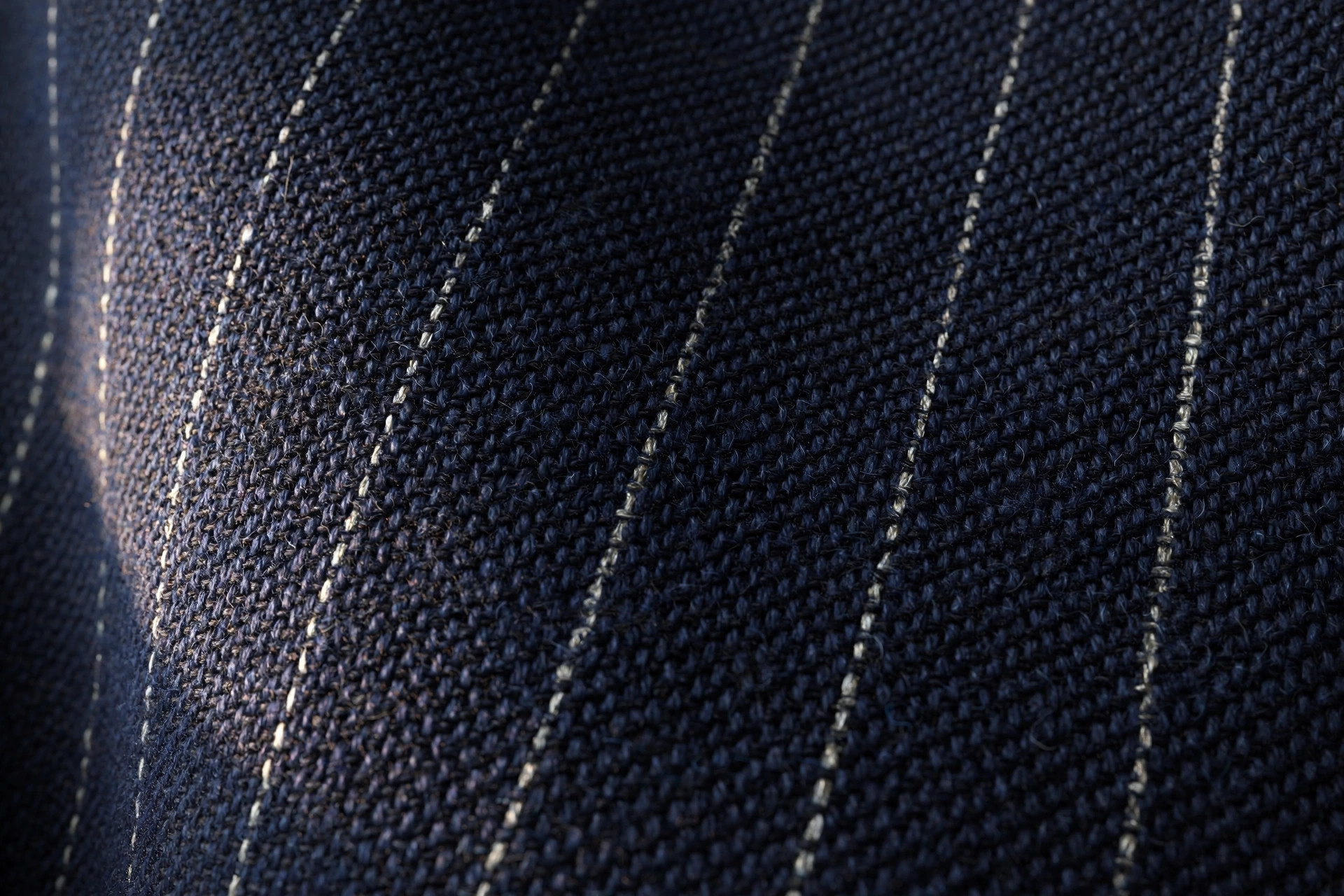
Two distinctions keep you out of trouble at the tailor:
- Pinstripe vs. chalk stripe. The chalk stripe is the pinstripe's wider, softer cousin — a broader line with slightly blurred edges, as if drawn in tailor's chalk, usually on flannel. Where the pinstripe is sharp and formal, the chalk stripe is softer and more sporting. Both are classic. They are not the same thing, and calling one the other is the fastest way to lose a tailor's respect.
- Pinstripe vs. any stripe. Not every striped suit is a pinstripe. Bengal stripes, candy stripes, and pencil stripes are all wider and bolder. If you can read the stripe clearly from across the room, it is probably not a pinstripe. The pinstripe rewards a second look.
Stripes can be woven into the cloth or printed on top of it. In a good suit, they are woven in — the pattern is part of the fabric, not sitting on it. That is one of the first things worth checking when you buy (more on that in Section 5).
2. Where the pinstripe came from
Every great pattern has an origin story. The pinstripe has two, and honesty requires saying so: the most repeated version is a tradition, not a settled fact, and historians offer a rival account. Both are worth knowing.
The bank story. The version you will hear most often sets the scene in London, where banks are said to have dressed their employees in distinct striped patterns so that each institution's men could be told apart at a glance. Over time, the story goes, the stripes stopped being an identifier and became an emblem: the uniform of money, seriousness, and ambition. It is a good story, and it explains the pinstripe's permanent association with finance. But the sources disagree on the details — some tellings place it in the 19th century, others in the early 1920s — and no single document settles it. Treat it as the tradition it is: widely told, plausibly rooted, not proven.
The sporting story. The rival account traces the stripes to leisure, not ledgers — to the striped uniforms of 19th-century sporting and boating clubs, where vertical stripes were stylish, functional, and visible. On this telling, the pattern moved from the river to the office, not the other way around.
What is not in doubt is the timeline that follows. Pinstripes appear on suits from the early 19th century onward. At first they showed up mainly on trousers; when the look crossed to the United States in the 20th century, the stripes moved onto jackets too, and the full pinstripe suit was born. The word's trail runs even further back: references to "pin-stripe stuff" appear in Geoffrey Chaucer's The Canterbury Tales, written in the late 1300s — the pattern's name is older than the suit itself.
Then the pattern went to the ballpark. The Boston Nationals' uniforms carried pinstripes from 1907, recognized as the first Major League Baseball team to wear them. Other clubs followed, and one in particular made the look immortal: the New York Yankees adopted pinstripes in the 1910s, and the uniform became so identified with the team that the stripes themselves became a symbol of winning. Basketball followed later, with teams like the Chicago Bulls, Charlotte Hornets, and Orlando Magic putting pinstripes on the court.
And then came the image that fixed the pinstripe in the modern mind. Tom Wolfe's 1987 novel The Bonfire of the Vanities gave the 1980s its defining label — the "Masters of the Universe" — for the young Wall Street traders at the top of the world, and the pinstripe suit became the visual shorthand for that power: banker stripes, wide lapels, braces, the whole silhouette of the decade's ambition. On screen, Gordon Gekko's striped suits in Wall Street (1987) did the rest. Decades later, The Wolf of Wall Street (2013) gave the same stripes a louder charge — the pinstripe as the uniform of a life lived at full throttle: luxury, money, and everything that comes with it. The pattern also traveled the other way, into the gangster film, where Prohibition-era figures made the same stripes read as a different kind of power — the kind that does not ask permission. That double life, boardroom and backroom, is exactly why the pinstripe still holds attention. It has always been the pattern of men who intend to be noticed.
That is also why this magazine carries the name. Our own About page traces it in a section called "The Pinstripe Legacy: Power Evolving" — the go-getter who balances sharp style with a strategic mind, and the long line of power dressers, from Wall Street titans to screen gangsters, who wore the stripe before him. This guide is the longer version of that story.
3. How to wear pinstripes today
The pinstripe's great advantage is that it never actually left. It relaxes, it sharpens, it goes casual and comes back formal — but the rules for wearing it well have stayed steady. Here they are.
Start with fit, not pattern. A pinstripe magnifies everything about a suit's fit, good and bad, because the eye follows the lines. Shoulders should sit where your shoulders end. The jacket should close without pulling. Trousers should break just at the shoe. Get the fit right and the stripes do the rest; get it wrong and no stripe width will save you.
Pick your ground. Navy is the most versatile pinstripe ground — it works in the office, at weddings, and after dark. Charcoal grey is a close second, slightly quieter. Black pinstripes read sharper and more evening. Lighter grounds (pale grey, cream) exist and can look superb in warm weather, but they are a statement — earn them after you own the dark ones.
Mind the spacing. Closely spaced stripes read subtle and formal; wider spacing reads bolder and more fashion-forward. For a first pinstripe suit, stay close and fine. For a second, go a touch wider and let the pattern show a little more personality.
Keep the rest of the outfit quiet. The pinstripe is the statement, so everything around it should support, not compete:
- Shirt: solid white or light blue. A fine, quiet pattern is acceptable; a loud one fights the suit. When in doubt, solid wins.
- Tie: solid or lightly textured. A tie with its own bold stripes against a striped suit is the classic mistake — two patterns arguing. If you love striped ties, wear them with solid suits.
- Shoes: black oxfords for formal, dark loafers or clean white sneakers only when you are deliberately dressing the suit down (see separates, below).
- Accessories: this is where the details earn their keep — a good watch, a pocket square that picks up the stripe color without matching it exactly, and nothing that jingles. Our guide to suit accessories for men covers the full kit.
Wear it where it belongs. The pinstripe suit's natural homes are the office, the wedding, and the formal evening. It is the suit that says you came prepared. For a deeper look at how the same suit reads in a professional setting, see our piece on whether pinstripe suits are fashionable for lawyers. For taking one look from day to night, the principles in our day-to-night style hacks apply directly: change the shirt, lose the tie, change the shoes, and the same suit changes its register.
Break it up: separates. The most modern way to wear pinstripes is not as a suit at all. Pinstripe trousers with a plain knit sweater, a white tee, or an overshirt — finished with clean trainers — take the pattern out of the boardroom entirely. The same goes for a pinstripe jacket worn as a blazer over dark denim or plain trousers. The rule is one striped piece at a time. Two is a gamble; three is a costume.
The mistakes that matter. Mixing two competing stripe patterns. Choosing a stripe so wide it reads as a costume. Wearing the full suit with a striped shirt and a striped tie. And the quiet killer: a suit that does not fit, which the stripes will announce to everyone in the room.
4. Pinstripes in modern style and culture
The pinstripe keeps coming back because designers keep rediscovering what it does: it gives structure to a silhouette and authority to the person inside it. Recent runway seasons have put pinstriped two-pieces back in front of audiences, styled relaxed — oversized trousers, chunky knits under pinstripe blazers, stripes in olive and oxblood alongside the traditional navy, grey, and black. Street style has followed, pairing pinstripe tailoring with trainers and treating the pattern as texture rather than uniform.
The pattern has also outgrown the suit. Pinstripe shirts, trousers, skirts, and even relaxed pieces like overshirts and joggers now carry the stripe, part of the same loosening that has relaxed dress codes everywhere. The through-line is the same as it was a century ago: thin lines, worn with intent, read as confidence.
Women's tailoring claimed the stripe too, most visibly in the 1980s power-dressing era, when sharply tailored pinstripe suits with strong shoulders became a symbol of ambition and equality for women entering professions that had been closed to them — a moment carried by public figures and by films like Working Girl. The stripe has never belonged to one gender. It belongs to anyone dressing with purpose.
Through all of it, the association has held. Say "pinstripe" and people picture the same thing: the suit, the stance, the room. That is why the word is this magazine's name — and why this guide exists. Pinstripe is the magazine of that life: the power and all the cool items that come with it — the suits, the watches, the gadgets, the rooms, the trips — covered the way the stripe itself wears: sharp, confident, and clean.
5. Buying and caring for pinstripes
What to look for when you buy.
- Woven, not printed. Run a finger over the stripe. In a quality cloth the stripe is part of the weave; in a cheaper one it sits on the surface and will fade and wear unevenly.
- Stripe match. At the seams — shoulders, pockets, the trouser outseam — the stripes should line up. Misalignment at a seam is the clearest visible sign of corner-cutting.
- Cloth weight. A mid-weight wool worsted is the workhorse: it drapes, it breathes, it holds the line of the stripe. Very light cloths wrinkle and lose the stripe's crispness; very heavy ones are for winter only.
- The mirror test. Put it on and step back. The stripes should fall straight from shoulder to hem without bowing or wavering. If they curve, the cut is fighting the cloth.
- One good suit before two average ones. A single well-made navy pinstripe suit, worn often and cared for, out-earns two mediocre ones. For a wedding or a first serious suit purchase, our guide to affordable wedding suit brands is a useful starting point on where the value is.
How to care for it.
- Dry clean sparingly. Cleaning wears cloth out; wear wears it in. Brush the suit after wearing, air it on a proper hanger, and clean only when it is actually soiled or smells.
- Press with the stripe. When pressing, follow the line of the stripe and use a cloth between iron and fabric. A good steamer handles most wrinkles without the risk.
- Hang properly. Wide, shaped hangers that support the shoulder; trousers hung by the cuff or crease so the stripe hangs straight. Never fold a suit into a drawer for storage.
- Rotate. Give the suit a day or two of rest between wears. Wool recovers its shape when it rests, and the stripes stay crisp longer.
Sources & further reading
These are the sources the history and definitions in this guide were drawn from and summarized in the author's own words. They are the places to go deeper.
- Merriam-Webster, "pinstripe" — definition and first known use (1863). https://www.merriam-webster.com/dictionary/pinstripe
- Wikipedia, "Pinstripes" — pattern definition, suit and baseball history, Chaucer reference, chalk stripe comparison. https://en.wikipedia.org/wiki/Pinstripes
- MR PORTER, The Journal, "Seven Men Who Prove Suits Are the Ultimate Power Move" — Tom Wolfe, the Masters of the Universe, and the power-suit image. https://www.mrporter.com/en-ca/journal/fashion/seven-men-who-prove-suits-are-the-ultimate-power-move-919022
- FashionBeans, "How to Wear Pinstripe Trousers the Modern Way" — modern and casual pinstripe styling. https://www.fashionbeans.com/article/how-to-wear-pinstripe-trousers/
- Hello! Magazine, "Pinstripes are back on the agenda for AW24" — the runway revival and the Canterbury Tales / London banks tradition. https://www.hellomagazine.com/hfm/wish-list/731664/best-pinstripes-to-shop-now/
- Stile MilleLire, "The History of the Pinstripe Suit and Its Association with the American Gangster" — the two origin theories and the gangster association. https://www.stilemillelire.com/en/the-pinstripe-suit-and-the-american-gangster/
- ApparelSearch, "Men's Pinstripe Pants Guide" — pinstripe vs. chalk stripe distinction. https://www.apparelsearch.com/clothes/mens/p/pinstripe_pants_guide_mens_pinstripe_pants.htm